The Student-Led IEP Process
Do you want to learn more about the Student-Led IEP Process (SLIEP)?
Learn all your answers to who, what, when, where, why, and how you and others can be part of the Student-Led IEP Process! Are you interested in Professional Development or Technical Assist
Request a Training
Learn more about the SLIEP.
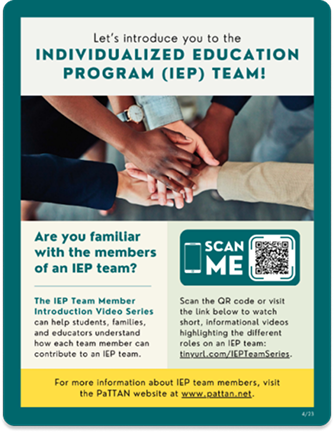
The student, the family, and school staff can all be part of the Student-Led IEP process. Each team member can play an important part in helping to support the student and in providing information. Any student, of any age and any ability, can be part of the Student-Led IEP process. Check out the set of videos, in the button below these questions, that highlights the many people who can be involved in the SLIEP. The animated videos describe the roles and the benefits of having each person on the team.
IEP Team Members: Animated Videos
An IEP is an Individualized Education Program for students in special education who need specially designed instruction. For more specific information, visit our IEP information tab.
What is an IEP ?
Students can choose to engage in any section of the IEP within the SLIEP process, including present levels, specially designed instruction, progress monitoring, goals, and related services providers.
Students can be included as soon as they begin receiving special education services.
Why should an IEP become a Student-Led IEP?
Because the Student-Led IEP process benefits EVERYONE!
For Youth
The Student-Led IEP Process: It's Good for Students!
Explore More
For Teachers and School Staff
The Student-Led IEP Process: It's Good for Teachers & School Staff!
Explore More
For Families
The Student-Led IEP Process: It's Good for Families!
Explore More
How can an IEP be used in the Student-Led IEP process?
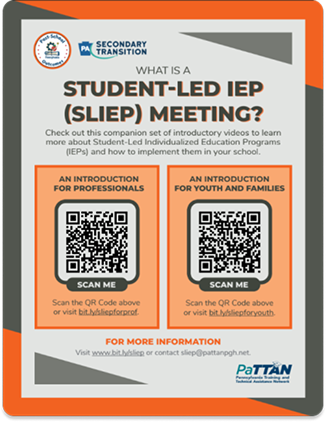
Check out these videos to learn more about the student-led IEP process and how to bring it to your school!
Still Have Questions ?
sliep@pattanpgh.net
Engaging Families in the IEP Process
It is the responsibility of the school to engage families, but it can be unclear how to do this. This document will explore how schools can reframe the IEP process and take active steps to include families as educational partners.
Explore More
Annotated IEP Companion Checklist
The purpose of this document is to support the participation, development, and implementation of an Individualized Education Program (IEP). Each section provides questions to help guide discussion. Utilize the IEP Planning Notes column to support your planning and participation for an upcoming IEP meeting.
IEP Document
English Language Learners
The Guide for English Language Development Specialists is an IEP companion checklist. Each section provides questions to help guide discussion. Utilize the IEP Planning Notes column to support your planning and participation for an upcoming IEP meeting.
Guide for English Language Development Specialists
Communication Plan of the IEP
The Communication Plan is a required part of the IEP process for students who are deaf/hard of hearing or deafblind. It should be completed at the beginning of the IEP meeting. The revised format asks for data to support answers and for input from all the members of the team: the student, the family, and the professionals.
View Communication PlanAnnotated Communication Plan of the IEP
This annotated version of the Communication Plan has notes and hints that can help all the members of the team work on the plan, together, at the beginning of the IEP meeting.
Annotated Communication Plan